
Monday Memo 1263: One Purpose, Many Expressions
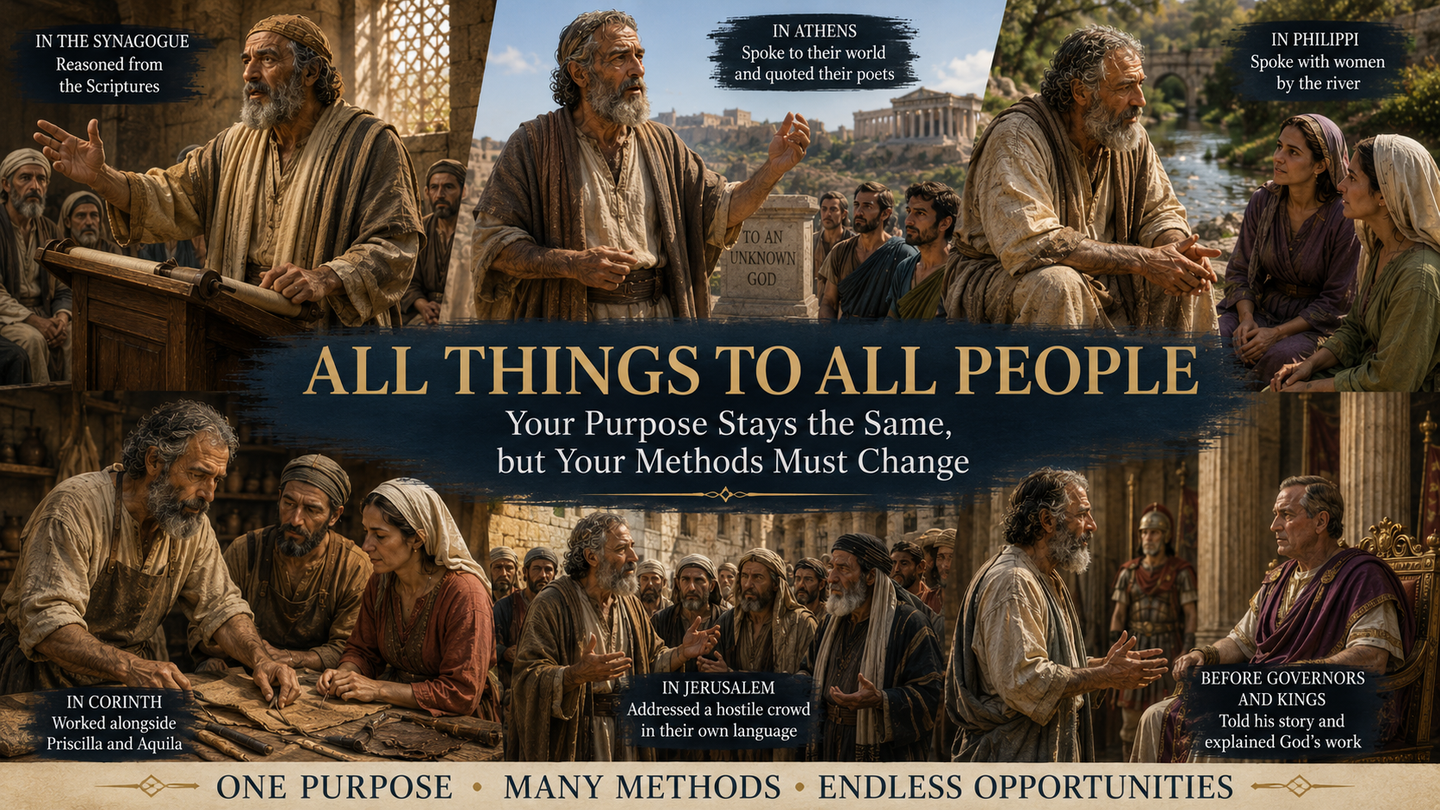 Paul made an interesting statement about how he carried out his purpose:
“I have become all things to all people so that by all possible means I might save some” (1 Corinthians 9:22).
Paul knew exactly what his purpose was. He had been set apart to take the gospel to the Gentiles, and that assignment remained remarkably consistent throughout his life. Yet while his purpose did not change, his methods certainly did.
When Paul entered a new city, he paid attention to the people who lived there. If there was a synagogue, he usually started there and reasoned from the Scriptures. When he went to Athens, however, he encountered philosophers and intellectuals who knew little or nothing about the Jewish Scriptures. Instead of beginning where he usually did, Paul started with something they understood—an altar inscribed “TO AN UNKNOWN GOD” (Acts 17:23). He even quoted their own poets to help communicate his message.
Paul adjusted his approach without compromising his message. He understood something that everyone who wants to fulfill their purpose must eventually learn: Your purpose may remain the same throughout your life, but the way you express it must change.
I have seen people become so attached to a method that they confuse it with their purpose. A pastor may think preaching behind a pulpit is his purpose when his purpose may actually be teaching. An author may think writing books is the purpose when writing is simply one way to communicate ideas. A businessperson may think owning a particular company is the purpose when the company is only one vehicle through which their purpose is being expressed.
When the vehicle changes, they panic because they think they have lost their purpose. They haven't. They may simply need a new vehicle.
I've had to learn that lesson throughout my own life. My purpose has remained remarkably consistent, but the ways I express it have changed many times. I've preached sermons, taught classes, written books, coached individuals, consulted with organizations, published other people's work, recorded videos and podcasts, conducted Zoom meetings, written daily devotionals, and traveled around the world. Today, my books are being translated into other languages so ideas I developed years ago can reach people I've never met.
The methods changed, but the purpose didn't.
That requires creativity. If you know what God created you to do, then you should constantly be asking, “What are some new ways I can do it?” Technology changes. Cultures change. Audiences change. Opportunities change. You change. If you insist on doing things the way you've always done them, you may remain faithful to an old method while becoming ineffective in your purpose.
Paul didn't do that. In Philippi, he spoke to women gathered by a river. In Athens, he addressed philosophers. In Corinth, he worked alongside Priscilla and Aquila while establishing a church. In Jerusalem, he addressed a hostile Jewish crowd in their own language. Before governors and kings, he told his personal story and explained what God had done in his life. The purpose was consistent, but Paul adapted his approach to the people and circumstances before him.
That is what he meant when he said he became “all things to all people.” He wasn't being dishonest or pretending to be someone he wasn't. He was willing to meet people where they were rather than insisting they come to where he was.
There is an important distinction here. You should never compromise your values simply to gain acceptance, but you should be willing to change your vocabulary, methods, presentation, technology, and approach if doing so helps you fulfill your purpose more effectively. Flexibility isn't compromise. It is often wisdom.
Some people are waiting for God to restore an old opportunity when He may be offering them a new method. They want the old platform, the old audience, the old job, or the old way of doing things. Perhaps the better question isn't, “How can I get back to what I used to do?” but, “How can I express my purpose effectively where I am today?”
Paul knew his purpose well enough that he could afford to be flexible. He didn't have to protect a method because his identity wasn't tied to one. He could enter a synagogue one day, a marketplace the next, a lecture hall after that, and eventually write letters from prison. Wherever he was and whoever was in front of him, he found a way to fulfill his purpose.
That's an important lesson for all of us. Don't fall so in love with the method God used yesterday that you miss the method He wants you to use today. Know your purpose, hold firmly to your values, and then be creative and flexible in finding every possible way to express it.
Paul became all things to all people because reaching people mattered more to him than preserving his preferred methods. Your purpose may stay the same for a lifetime, but fulfilling it will require you to keep growing, adapting, and finding new ways to reach the people God puts in your path.
Your Turn
What method of expressing your purpose may have worked well in the past but needs to change today? What new technology, audience, opportunity, or approach could help you express your purpose more effectively?
What Would Paul Ask You?
Are you committed to your purpose, or have you become more committed to the way you've always carried it out?
Purpose Moment
Thank God for the purpose He has entrusted to you, and ask Him for the creativity and wisdom to express it in new ways. Be willing to change your methods without compromising your values so you can become more effective with the people and opportunities He puts before you.