
Monday Memo 1268: The Altar of Privacy
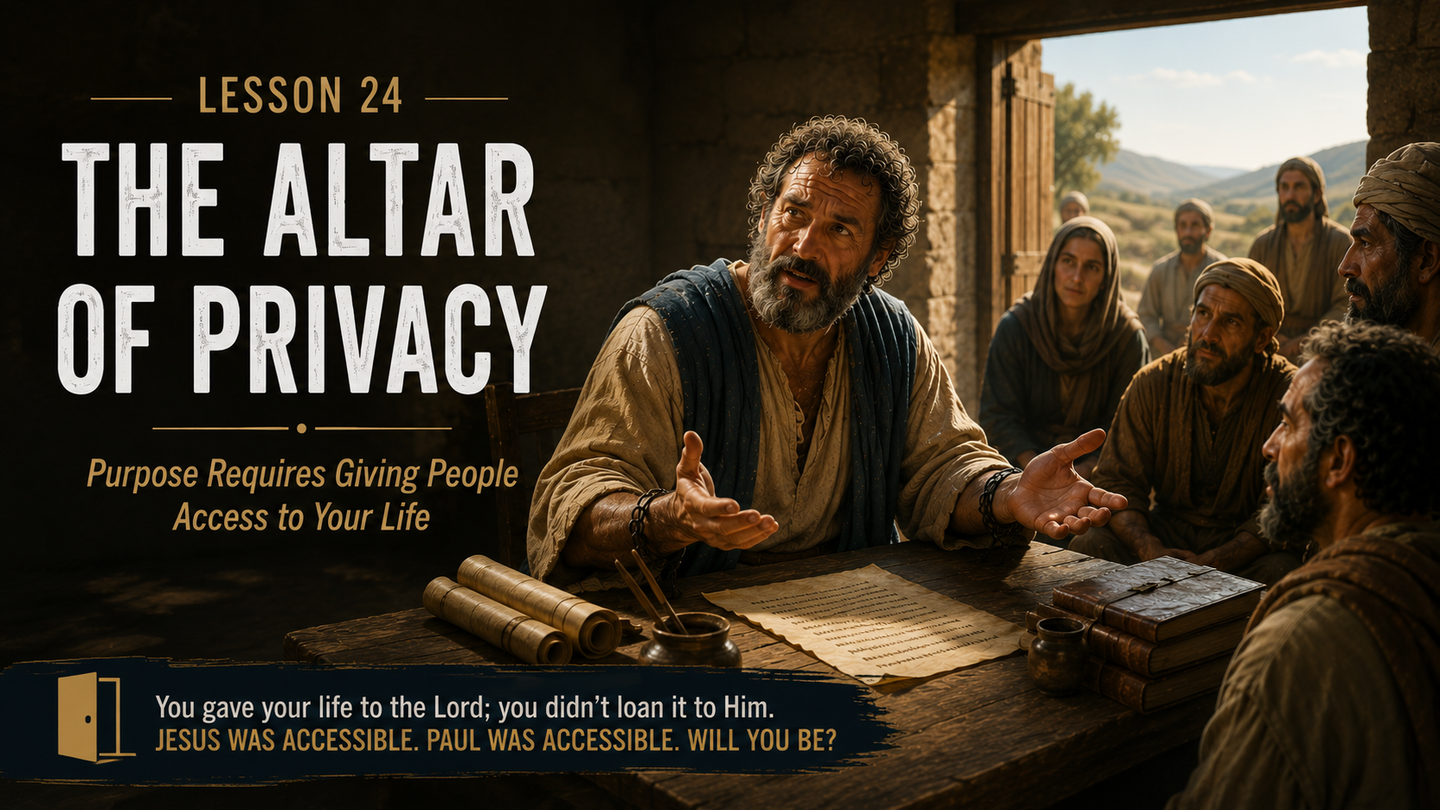 Purpose is never just about you. Whatever God created you to do ultimately has someone else as its beneficiary. Teachers need people to teach, encouragers need people to encourage, leaders need people to lead, writers need readers, and those with a gift of mercy need people who need mercy. If your purpose is going to benefit others, then at some point those people are going to need access to you.
That can be a problem in a culture where many people worship at what I call the altar of privacy. We want to protect our time, our space, our schedule, our home, and our peace. Certainly there's nothing wrong with privacy, and everyone needs boundaries and time alone. Jesus Himself withdrew from people to pray and rest. Yet privacy can become such a high priority that we protect ourselves from the very people God wants us to serve.
When you gave your life to the Lord, you gave it to Him. You didn't loan it to Him with conditions concerning when, where, and how He could use it. If He gave you a purpose that involves people—and all purpose eventually does—then those people are sometimes going to interrupt your schedule, ask questions when you would rather be doing something else, need help at inconvenient times, or require you to share parts of yourself you would prefer to keep private.
Jesus modeled this kind of accessibility throughout His ministry. Children could approach Him. Sick people could touch Him. Crowds followed Him from place to place. People interrupted Him while He was traveling, eating, teaching, and resting. His disciples lived and traveled with Him, which meant they saw Him when He was tired, hungry, under pressure, and confronted by opposition. Even His enemies had enough access to Him to question, argue with, insult, and eventually betray Him.
Jesus had boundaries, but He didn't build His life around protecting Himself from people. He understood that people were the reason He had come. His purpose required accessibility, and the same was true for Paul.
Paul's life was remarkably open. He also traveled with a team, so other people saw him at his best and worst. They watched him preach, work, suffer, make decisions, handle opposition, endure disappointment, and resolve conflict. Even his tentmaking put him in contact with people, including Aquila and Priscilla, whom he met because they shared the same trade (Acts 18:1-3).
Paul was also accessible through his writing. His letters weren't impersonal theological textbooks. He shared his fears, struggles, weaknesses, disappointments, conflicts, suffering, and even his past failures. He reminded people that he had persecuted the church. He told them about his thorn in the flesh. He described his hardships and admitted there were times when he was afraid. Paul wasn't reluctant to use his own life as part of the lesson because his life belonged to God and therefore could be used to help others.
That's why Paul could write, “Follow my example, as I follow the example of Christ” (1 Corinthians 11:1). You can't invite people to follow your example if you never allow them close enough to see it. Paul understood that purpose wasn't simply something he taught; it was something he lived in front of others.
Then Paul arrived in Rome, where his accessibility took another form. He could no longer travel freely because he was under house arrest and chained to a Roman guard, yet Luke tells us, “For two whole years Paul stayed there in his own rented house and welcomed all who came to see him” (Acts 28:30). His freedom of movement had diminished, but his willingness to receive people hadn't.
I find that significant because Paul had every excuse to withdraw. He had spent years traveling, preaching, suffering, being beaten, arrested, opposed, and misunderstood. He could have decided that his imprisonment was finally his opportunity to protect his privacy and enjoy some peace. Instead, he opened his door and welcomed whoever came.
I've had to learn that same lesson over the years. It's all about God's people and not about me. And that for me has taken me on a journey through technology to social media, where I have shared what I know, where I am, and what I am learning with as broad an audience as possible. God convicted me years ago that I didn't value what He gave me because I didn't share it. That meant I had to make myself accessible to as many people as possible because I am a teacher, leader, and writer.
That doesn't mean you have to answer every phone call, accept every invitation, or allow everyone unrestricted access to your life. Accessibility isn't the absence of boundaries. Jesus sometimes withdrew from the crowds, and Paul didn't allow other people's expectations to determine everything he did. The issue is whether your boundaries protect your ability to fulfill your purpose or protect you from fulfilling it.
There's a significant difference between the two. Rest can prepare you to serve people, while isolation can become a way of avoiding them. Privacy can restore you, but it can also become an excuse for protecting a comfortable life. If you're serious about purpose, then you must accept that purpose can be messy because people are messy. They don't always arrive at convenient times, respond as you expect, appreciate what you do, or respect the investment you make in them. Jesus experienced that, and so did Paul.
There's another side to accessibility we sometimes overlook. We may tell God we're willing to serve, but quietly assume we'll get to determine the size and scope of that service. Yet if God wants to make you a household name in His service, He doesn't need your permission—just your cooperation. Paul didn't set out to become one of the most recognizable names in Church history, but once God chose to give him influence, Paul had to accept everything that came with it, including the demands, scrutiny, criticism, interruptions, and loss of privacy.
Perhaps the question we should ask ourselves when we talk about fulfilling our purpose. Not simply, “What am I called to do?” but also, “Who needs access to me so I can do it?” Your purpose isn't something God gave you to admire, protect, or enjoy privately. He gave it to you so it could benefit others.
Don't worship at the altar of privacy. Establish healthy boundaries, get the rest you need, and protect the time required to prepare and be productive, but remember that you gave your life to the Lord; you didn't loan it to Him. Jesus was accessible. Paul was accessible. If God wants to make you a household name in His service, that's His business, not yours. Whether He sends one person to your door or puts your life before the crowds, be willing to give appropriate access to what He has placed in you.
Your Turn
Have you established healthy boundaries that help you fulfill your purpose, or have you built walls that keep people from benefiting from what God has placed in you? Who may need greater access to your time, experience, wisdom, gifts, or story?
What Would Paul Ask You?
Are you protecting your privacy so carefully that you're also protecting yourself from some of the people God wants you to serve?
Purpose Moment
Thank God for the people He has brought into your life and ask Him for wisdom to know when to withdraw and when to be available. Ask Him to help you establish healthy boundaries without allowing comfort, privacy, or convenience to interfere with the purpose He has given you to serve others.